
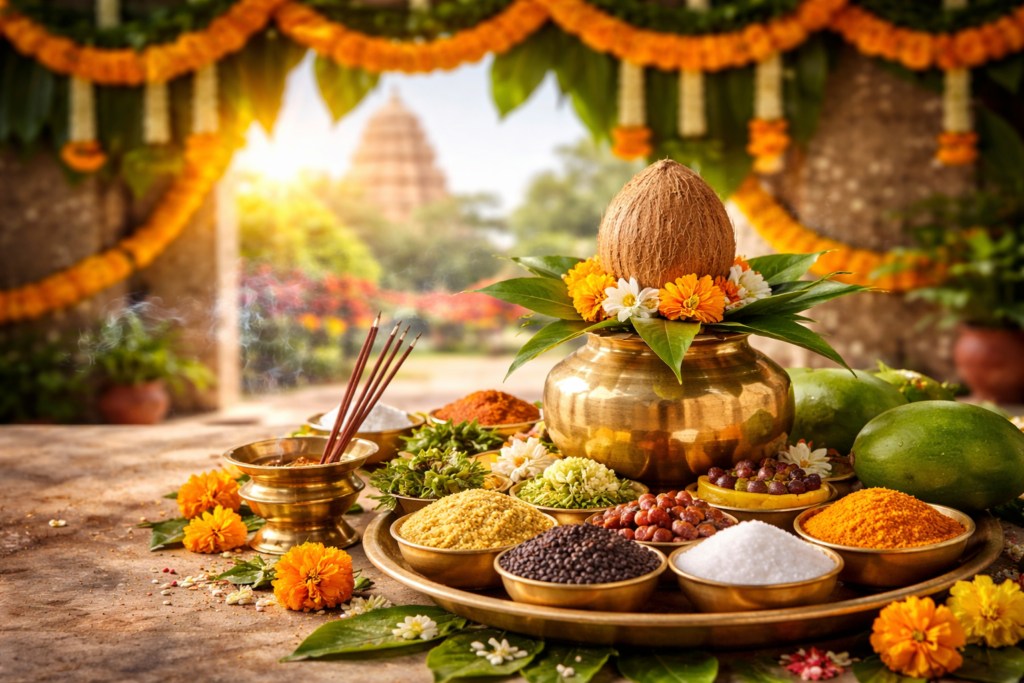
Ugadi is the traditional New Year festival celebrated mainly in the states of Andhra Pradesh, Telangana, and Karnataka. The word Ugadi comes from the Sanskrit word “Yuga” (age) and “Adi” (beginning) meaning the beginning of a new era. In 2026, Ugadi will be celebrated on March 19. The festival marks the beginning of Chaitra Shukla Pratipada in the Hindu lunisolar calendar and symbolizes renewal, hope, prosperity, and spiritual awakening.
Ugadi in the Puranas
According to sacred texts like the Brahma Purana, Bhavishya Purana, and Padma Purana, the day of Chaitra Shukla Pratipada is believed to be the moment when Lord Brahma began the creation of the universe.
Ugadi Traditions and Rituals
Ugadi traditions begin with an auspicious oil bath followed by wearing new clothes. Homes are decorated with mango leaf toranas, colorful rangoli designs, and fresh flowers, and special poojas are performed to seek divine blessings for the year ahead.
One of the most important rituals is the preparation of Ugadi Pachadi in a new mud pot containing six tastes: fresh neem flowers, jaggery, tamarind, black pepper, salt, and fresh raw mango. Each ingredient represents different emotions and experiences of life, symbolizing the acceptance of both joy and hardship in the coming year.
Another unique tradition is Panchanga Shravanam, where priests or elders read the new year’s Hindu Panchangam. It consists of five elements: Tithi (angle between the Sun and Moon), Vara (Earth’s rotation or weekday), Nakshatra (Moon’s position among the stars), Yoga (combined influence of the Sun and Moon), and Karana (half of a Tithi).
India celebrates the New Year not just by date but according to the cosmic cycles of the Sun and Moon.
Types of New Year Celebrations in India
March New Year follows the lunar system and includes festivals like Ugadi. April New Year follows the solar system when the Sun enters Aries (Mesha Sankranti). Some regions, such as Gujarat, celebrate the New Year after Diwali.
Regional Celebrations in March – April
During March and April, Ugadi is celebrated in Andhra Pradesh, Telangana, and Karnataka, while Maharashtra and Goa observe Gudi Padwa. Chaitra Navratri is celebrated across Uttar Pradesh, Madhya Pradesh, Bihar, and other northern states. Cheti Chand marks the New Year of the Sindhi community, and Navreh is celebrated in Jammu and Kashmir.
Solar New Year Celebrations in Mid-April
Between April 13 and 15 each year, another major New Year period occurs based on the Sun entering Aries (Mesha Sankranti). This includes Puthandu in Tamil Nadu, Vishu in Kerala, Baisakhi in Punjab, Bohag Bihu in Assam, Pohela Boishakh in West Bengal and Tripura, and Pana Sankranti in Odisha.
Other Regional New Year Celebrations
India’s diversity is reflected in several other New Year traditions observed at different times of the year. Losar is celebrated in February in Ladakh and Himalayan regions. Ashadhi Bij is observed in July–August in Gujarat’s Kutch region. The Parsi community celebrates its New Year in August. Bestu Varas, the Gujarati New Year, is celebrated in October or November after Diwali. Based on regional customs and calendars, New Year is celebrated throughout the year across India.
Chaitra Navratri and Sri Rama Navami
Chaitra Navratri is observed from Chaitra Shukla Pratipada to Shukla Navami and is considered one of the most auspicious periods in the Hindu calendar. These nine sacred days are also known as Chaitra Navratri, Durga Navratri, and Rama Navratri, each highlighting a unique spiritual significance. The ninth day, Navami, marks the divine birth of Lord Rama and is celebrated as Sri Rama Navami or Sri Rama Jayanti.
Grand Celebrations at Bhadrachalam
In Telangana, the sacred town of Bhadrachalam becomes the center of grand festivities during Sri Rama Navami. The famous Sri Sita Ramachandra Swamy Temple hosts the magnificent Kalyana Mahotsavam, symbolizing the celestial wedding of Lord Rama and Sita.
A unique and revered tradition is followed in which the Chief Minister of Telangana offers pearls known as “Mutyala Talambralu” on behalf of the state. This ritual reflects deep devotion and royal honor, making the celebration one of the most prestigious Rama Navami events in India.
During these nine sacred days, devotees worship Goddess Durga in her various forms, including the Navadurga. Advanced spiritual practices such as Das Mahavidya Pooja and Sadhana are performed by gurus, saints, and dedicated disciples.
Sri Rama Navami also coincides with Tara Jayanti, dedicated to Goddess Tara, the second among the Das Mahavidyas, adding deeper tantric and spiritual importance to the day. Many devotees also perform Chandi Homam for all nine days or at least on Shukla Paksha Ashtami under the guidance and blessings of priests, seeking protection, strength, and prosperity for the year ahead.
