The First Woman in Hindu Puranas
Shatarupa is regarded in Hindu Puranic literature as the first woman and the mother of the human race. Along with her husband Swayambhuva Manu, she played a crucial role in the early stages of creation and the expansion of human civilization according to ancient scriptures.
They are considered the primordial ancestors of humanity. Their role was to establish human life, social order, and Dharma (righteous living) on earth.
The name Shatarupa comes from Sanskrit:
- Shata – meaning hundred
- Rupa – meaning forms or appearances
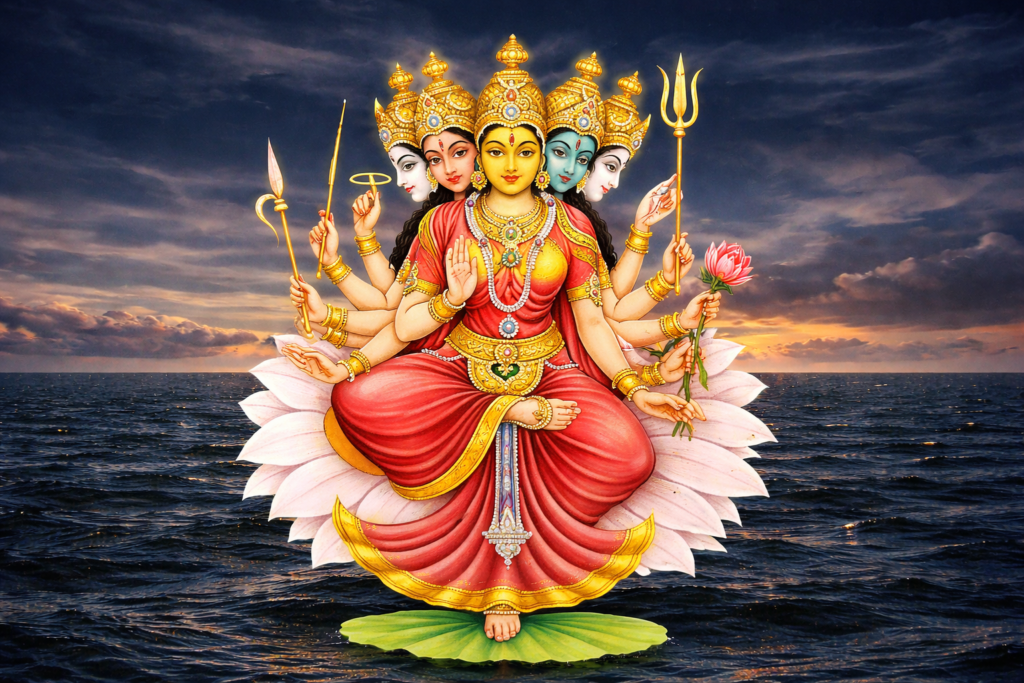
Thus, the name means “the one who possesses many forms” or “the woman capable of taking numerous forms.”
Symbolically, it represents the diverse nature and creative power of womanhood.
Marriage with Swayambhuva Manu
Shatarupa became the wife of Swayambhuva Manu, the first Manu and the progenitor of mankind.
In Hindu cosmology, each age (Manvantara) has a Manu who guides humanity and establishes the principles of Dharma.
Together, Manu and Shatarupa ruled the earth and established the earliest form of:
- Human society
- Cultural traditions
- Ethical principles
They laid the foundation for organized human civilization.
Children and Lineage
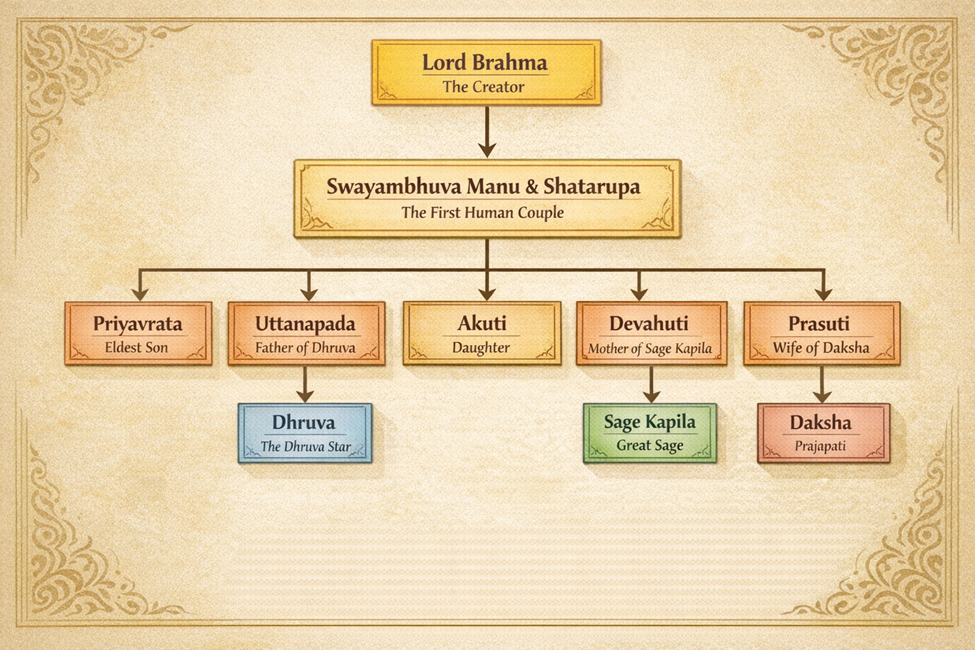
Shatarupa and Swayambhuva Manu had five children, who later became important figures in Hindu mythology.
Sons
Priyavrata
Priyavrata became a great king and a devoted ruler who later governed the earth.
Uttanapada
Uttanapada was the father of Dhruva, the great devotee of Lord Vishnu. Because of Dhruva’s intense devotion, he was granted immortality and became the Dhruva Star (Pole Star).
Daughters
Akuti
Akuti married the sage Ruchi.
Devahuti
Devahuti married the sage Kardama and later gave birth to Kapila, the great philosopher and founder of the Samkhya philosophy.
Prasuti
Prasuti married Daksha Prajapati, an important figure in many Hindu mythological stories.
Through these children, the lineage of Manu and Shatarupa expanded and became the foundation of many dynasties and spiritual traditions described in the Puranas.
Symbolic Meaning of Shatarupa
Shatarupa represents several spiritual and cultural ideas in Hindu philosophy:
- Motherhood and creation
- Feminine power (Shakti)
- The beginning of human society
- Harmony between masculine and feminine energies
In many interpretations, she is also viewed as a symbolic manifestation of the Divine Feminine Energy, similar to the broader concept of Shakti in Hindu philosophy.
References in Hindu Scriptures
Shatarupa is mentioned in several important Hindu scriptures, including:
- Bhagavata Purana
- Vishnu Purana
- Brahma Purana
These texts describe the creation of humanity and the genealogies that emerged from Manu and Shatarupa.
In Hindu tradition, Shatarupa is respected as the first woman and the mother of mankind.