
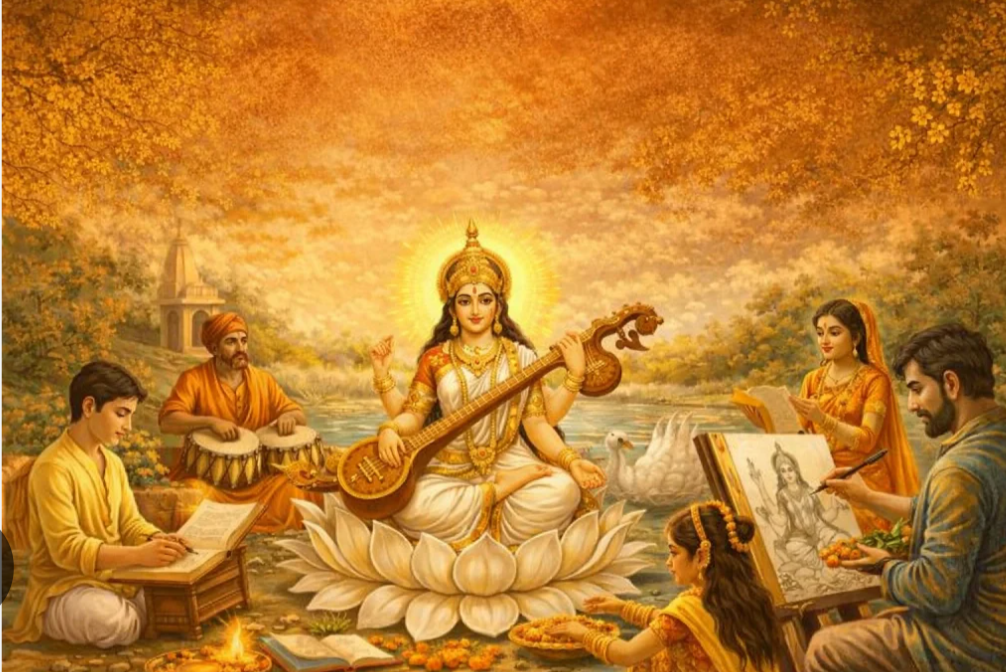
Significance of Vasant Panchami
Vasant Panchami occurs on the 5th day of Vasant Navratri, also known as Saraswati Navratri or Gupta Navratri. It is a highly auspicious and divine day, especially for students, teachers, scholars, artists, and musicians, as it is dedicated to Goddess Saraswati, the deity of knowledge, wisdom, learning, music, and arts.
Vasant Panchami is celebrated on Magha Shukla Panchami, and is also known as Sri Panchami and Madana Panchami. This sacred day marks the appearance (birthday) of Goddess Saraswati.
Date and Observance in 2026
In the year 2026, Vasant Panchami will be celebrated on 23rd February with great devotion and enthusiasm across India. The festival also signifies the beginning of the spring season (Vasant Ritu).
On this day, Lord Vishnu along with Goddess Mahalakshmi are worshipped. Rati and Manmadha (Kamadeva) are also revered to please Madhava (Vasant), and the celebrations are known as Vasantotsavam.
As mentioned in Vrata Chudamani, Brahmins are offered dakshina (money) or gifts during rituals as a symbol of gratitude and respect.
Worship of Goddess Saraswati
Goddess Saraswati is the embodiment of education, wisdom, creativity, and eloquence. On this sacred day:
- Children, students, teachers, orators, and devotees wear white clothes
- Special Saraswati Puja is performed using:
- White flowers
- White sandalwood (chandan)
- Honey
- White sweets such as sugar candy and milk-based offerings
Honey is traditionally consumed daily to enhance intelligence and speech abilities.
Aksharabhyasam (Initiation of Learning)
Vasant Panchami is considered highly auspicious for Aksharabhyasam, the ceremonial beginning of education for young children. Items such as slates, chalk, books, pens, and musical instruments are worshipped as part of the puja.
Symbolism of Goddess Saraswati
Goddess Saraswati is depicted holding a Veena, which represents the seven musical notes (Sa Re Ga Ma Pa Dha Ni).
It is believed that Lord Krishna worshipped Goddess Saraswati, mastered music, and later enchanted the world with his flute. The eight holes of the flute symbolize an expansion of the seven notes, creating a unique and mesmerizing sound known as Sammohana.
She is often adorned with a peacock feather, symbolizing the captivating and divine nature of music.
- Veena: Harmony of the universe
- Lotus: Spiritual growth and enlightenment
- White Swan (Hamsa): Purity, wisdom, and discernment
In every form, Goddess Saraswati represents knowledge, self-expression, creativity, and divine wisdom.
Difference Between Saraswati Devi and Sharada Devi
It is important to understand the distinction between the two divine forms:
- Goddess Saraswati is the consort of Lord Brahma
- Sharada Devi is the daughter of Lord Brahma (Brahmakumari)
Saraswati Navratri is observed from Magha Shukla Pratipada to Magha Shukla Navami, while Sharada Navratri is celebrated for five days from Ashwin Krishna Pratipada to Ashwin Krishna Panchami.
Important Saraswati Temples in India
Some of the most revered temples dedicated to Goddess Saraswati include:
- Gnana Saraswati Temple, Basar, Telangana
- Sri Sharadamba Temple, Sringeri, Karnataka
- Panachikkadu Saraswati Temple, Kottayam, Kerala
(also known as Dakshina Mookambika Temple) - Koothanur Maha Saraswati Temple, Tiruvarur, Tamil Nadu
- Vidhya Saraswati Temple, Medak, Telangana
- Saraswati Sharda Peetha, Pakistan
(One of the 18 Maha Shakti Peethas, sanctified by Adi Shankaracharya) - Mata Saraswati Temple, Uttarakhand
(Believed to be the birthplace of Goddess Saraswati) - Sharda Devi Temple, Maihar, Madhya Pradesh
- Saraswati Temple, Pilani, Rajasthan
- Wargal Saraswati Temple, Telangana
These temples hold immense spiritual significance and are deeply associated with learning, music, arts, and divine wisdom.
✨ May Goddess Saraswati bless everyone with knowledge, wisdom, creativity, and success. ✨
